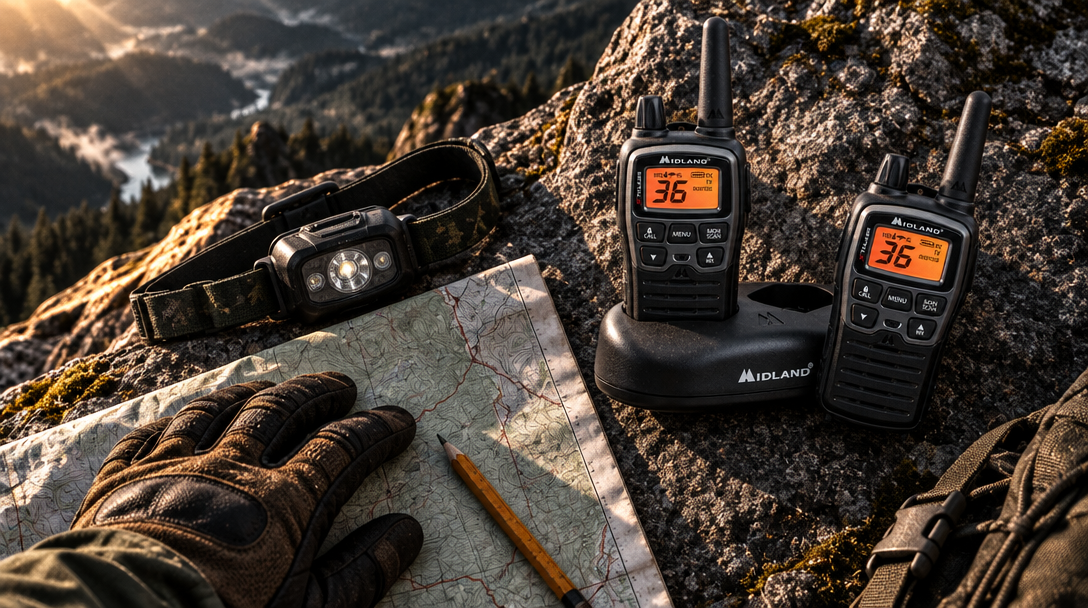
Every backcountry plan assumes the phone works until it does not. One bar disappears behind a ridge, the battery dies at the wrong hour, or the network is simply gone and there is no one to call. Comms is a skill and a plan before it is a device.
Here is how to build a small, reliable comms layer for a hunting party, a hiking group, or a household in an outage.
Start with the plan, not the radio
A radio with no protocol is a noisemaker. Decide four things before you leave the truck:
- Check-in times. Twice a day at fixed hours, for example first light and last light. Everyone stops and calls in.
- A missed check-in rule. If someone misses two, the group acts. Write the rule down so nobody has to guess at dusk.
- A rally point. One physical place everyone knows and can find without a device.
- Call signs. Short names, used consistently. "Hunter two" beats a full name in wind.
What two-way radios actually do well
Two-way radios work without a tower, a subscription, or a network. Press, talk, done. That is the whole appeal, and it is why they still belong in a pack in 2026.
What they do not do is punch through terrain. Range numbers on the box are best-case, line-of-sight figures measured in open country. Timber, hills, canyon walls, and rain all cut into that number, and deeply. Plan comms around the terrain you will actually be in, not the number on the packaging.
A pair of rugged handhelds such as the Midland X-Talker T71VP3 covers the everyday job: staying in contact on the trail, at camp, across a hunting unit, or between two vehicles. Two radios means one stays with the base camp or the truck.
Practical radio discipline
- Agree on a channel before you split up, and a backup channel in case the first is crowded.
- Get high to talk. Ten feet of elevation solves more comms problems than any accessory. Ridge to ridge, not valley to valley.
- Keep transmissions short. Say who you are, where you are, what you need.
- Battery discipline. Cold drains batteries fast. Carry spares, keep the radio inside a layer in freezing weather, and charge everything the night before.
- Test at the trailhead. A sixty-second check beats discovering silence three miles in.
Build in redundancy
The point of redundancy is that no single failure ends the plan:
- A whistle. Three blasts is the universal distress signal, it weighs nothing, and it works when your voice is gone.
- Paper. A printed map, a compass, and written phone numbers and rally points. Batteries die; paper does not.
- A light signal. Two headlamps, so one can signal while the other lights the way.
- A satellite messenger, if your trips are remote. It is a subscription device, not a substitute for the plan, but it removes the "nobody knows where we are" failure mode.
- Tell someone at home. Route, unit, vehicle, expected return. This is the cheapest comms upgrade available.
Kit that supports the plan
Comms works best when the rest of the loadout does not fight it. A compact pack that stays organized, glass that lets you confirm what you are looking at, and hydration you do not have to stop for all keep the party moving and talking.
- The Badlands ATX 12 Pack is the lightest, most compact model in the All-Terrain Xtreme lineup, with a molded foam suspension system and water-repellent fabric, sized for a day out rather than a week.
- The Leupold BX-1 Rogue Compact 10x25 gives you a way to confirm a shape at distance instead of calling it in blind.
- A compact laser rangefinder such as the Muddy LR850S turns "somewhere past that tree" into a number you can read over the radio.
- The Fieldline Surge Hydration Pack keeps water hands-free, so a check-in does not become a rest stop.
None of it replaces the plan. All of it makes the plan easier to keep.
Outage comms at home
The same thinking scales down to a house in a blackout. Phones become flashlights that die. A battery-powered receiver keeps you informed, a pair of handhelds keeps two people in contact across a neighborhood when the network is down, and a printed contact list and meeting point covers the gap that the network cannot.
Common questions
How far will my radios reach? Less than the box says. Expect reliable performance over shorter distances in timber and hills, and test your own setup in your own terrain.
Do I need a license? Some radio bands require one. Check the rules for the specific model and your country before you transmit.
Are two-way radios better than a satellite messenger? They do different jobs. Radios keep a group talking locally; a satellite messenger calls for help from anywhere. Serious trips carry both.
How many radios should a hunting party carry? At minimum, one per pair of people, plus one at base camp or the truck.
What is the simplest comms plan? Fixed check-in times, a rally point, and a rule for a missed call. Everything else is equipment.
The bottom line
Awareness, preparation, exploration. Decide the times, pick the channel, get high, and carry a whistle. A comms plan you have tested at the trailhead will outperform better gear you have never turned on.
Shop purpose-built field gear at Third Eye Survival.
This is where you will insert your Content for the Post 2 blog post.